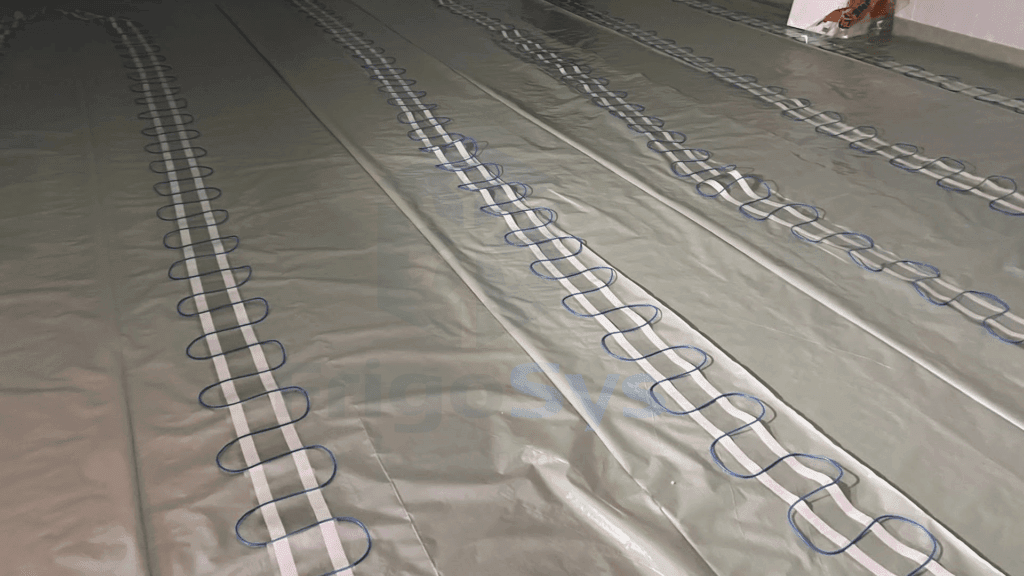


Floor heating in cold storage is used under freezer rooms. Below a room that runs under 0 °C for years, the cold slowly passes through the floor insulation into the ground. Moisture in the soil then freezes and expands. This frost heave lifts and cracks the floor slab and can damage the panels and the building. A heating layer under the floor insulation keeps the ground a few degrees above 0 °C and stops this.
When Does a Cold Room Need Floor Heating?
- Freezer rooms below 0 °C built on a ground slab: floor heating is needed, especially for large rooms and rooms that run all year.
- Blast freezer rooms on a ground slab: needed for the same reason.
- Chiller rooms at 0 °C and above: normally not needed, because the ground below does not freeze.
- Small freezer rooms standing on insulated floor panels with an air gap or on an upper floor: usually not needed.
What Floor Heating Does and Does Not Do
Floor heating protects the slab and the building from frost heave and extends the life of the floor. It does not improve the insulation and it does not save energy. It adds a small amount of heat under the floor, so the floor insulation above it must be thick enough to keep that heat out of the room. The heating layer is a protection system, not a substitute for insulation.
Cold Room Floor Construction Details (Freezer Rooms Below 0 °C)
A typical freezer room floor is built in these layers, from the ground up:
- Compacted ground and a lean concrete base.
- The heating layer: heating cables, heating mats or glycol pipes laid in a screed.
- A vapour barrier on top of the heated screed, on the warm side of the insulation.
- Rigid floor insulation laid in two layers with staggered joints, so no joint runs straight through.
- A slip and separation layer, such as PE film.
- The reinforced concrete wearing slab with its floor finish, designed for the forklift and racking loads.
The wall panels stand on the insulated floor so that the insulation runs without a break at the wall base. See our cold room construction guide for the full build.
Types of Floor Heating for Cold Storage
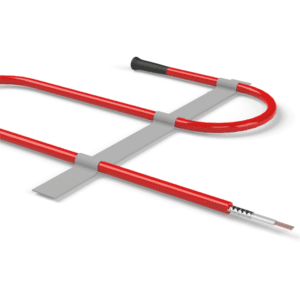
- Electric heating cables: fixed on a mesh and cast into the screed. Simple to install and control, suited to small and medium rooms.
- Electric heating mats: cables pre-fixed on a mat, laid out quickly on a level base.
- Glycol pipes: a warm glycol circuit in the screed, often heated with waste heat from the refrigeration plant. Suited to large cold stores, where it keeps running costs low.
Control and Monitoring
A temperature sensor in the heating layer and a thermostat keep the layer just above 0 °C, so the system works only as much as needed. A spare sensor laid next to the first one and an alarm on the control unit make faults easy to find before the ground starts to freeze.
Other Heaters in a Cold Storage Room
- Door frame heaters keep freezer door gaskets free of ice, for example the 220 V, 25 W/m silicone heater of our sliding freezer doors.
- Drain line heaters stop the defrost water of the evaporators from freezing in the pipe inside a freezer room.
Installation and Maintenance
The heating output is calculated for the room size and temperature before installation, and the base must be smooth and level. The cables or pipes are laid at even spacing and checked for damage before the screed is poured. Afterwards, check the sensor readings, the connections and the control unit regularly. Damage to cast-in cables is hard to repair, so careful laying and testing matter most. To size the refrigeration for a freezer room, use our heat load calculator, and see our blast freezer rooms.
Frequently Asked Questions
Does a chiller room need floor heating?
Normally not. At 0 °C and above the ground under the room does not freeze.
Electric cables or glycol pipes?
Electric cables are simpler for small and medium rooms. Glycol pipes suit large cold stores, where waste heat from the refrigeration plant can warm the circuit.
Does floor heating save energy?
No. It protects the floor from frost heave. Good floor insulation keeps its heat out of the room.
Can you supply and install abroad?
Yes. Our own team installs abroad, or a supervisor goes. Delivery takes 3–7 weeks, EXW or CIF.