
If you are planning a cold storage, food processing, pharmaceutical, or cannabis facility in the United States, one line item now decides whether the project gets insured at all: FM Approved PIR sandwich panels. What used to be a “nice to have” specification has quietly become the insurance market default. In 2026, property insurers increasingly refuse to write — or heavily surcharge — coverage on refrigerated buildings that are not built with FM Approved insulated metal panels.
For buyers evaluating cold room and panel suppliers, this changes the conversation. The question is no longer just “what is the R-value and the price per square foot?” It is “will this panel keep my building insurable?” This guide explains exactly what FM approval means, why polyisocyanurate (PIR) is the core material that qualifies, how the numbers work out, and what to look for when you specify panels for a U.S. project.
What “FM Approved” Actually Means
FM Approvals is the certification arm of FM (formerly FM Global), one of the largest commercial property insurers in the world. When a panel is described as FM Approved, it means the specific panel assembly has been tested and listed against FM’s fire-safety examination standards — not by the manufacturer’s own lab, but by an independent, insurer-backed testing body.
This is a critical distinction. “FM compatible,” “FM-grade core,” or “meets FM requirements” are marketing phrases. FM Approved is a formal listing: the exact panel construction — core material, facer steel, thickness, joint design, and fasteners — appears in FM’s approval database. If the panel is not listed, it is not FM Approved, no matter how good the fire performance sounds on paper.
Because FM is an insurer first and a test lab second, its standards are written around one goal: preventing the kind of catastrophic warehouse fires that have historically destroyed cold storage and food facilities. That underwriting perspective is why FM approval carries so much weight with U.S. risk engineers.
The Four FM Standards That Matter for Cold Storage
FM tests insulated metal panels under several examination standards, each targeting a different part of the building and a different failure mode. For cold storage and food-grade construction, four matter most:
- FM 4880 — Class 1 fire rating for interior wall and ceiling panels. This is the most commonly required standard for cold storage, food processing, and pharmaceutical interiors. A Class 1 rating means the panel does not self-propagate fire and, in many cases, does not by itself trigger a requirement for additional sprinkler protection.
- FM 4881 — Class 1 rating for exterior wall systems. This standard is far more aggressive than typical building code, adding structural and wind-load performance with a safety factor of 2.0 on top of the fire-propagation test.
- FM 4882 — Class 1 interior panels for smoke-sensitive occupancies. This applies to pharmaceutical manufacturing, cleanrooms, and sensitive food-preparation areas where smoke development, not just flame, is the concern.
- FM 4471 — Class 1 roof assemblies, often paired with wind-uplift ratings for panels used as roof decks in hurricane and high-wind regions.
Most real projects need a combination of these, not just one. A typical insured cold storage building specifies FM 4880 for the interior walls and ceilings, FM 4881 for exterior walls, and FM 4471 for the roof assembly. When you request a quote, ask which standards the panel is actually listed under — a panel approved for interiors is not automatically approved for exterior use.
Why PIR Qualifies and Standard Polyurethane Does Not
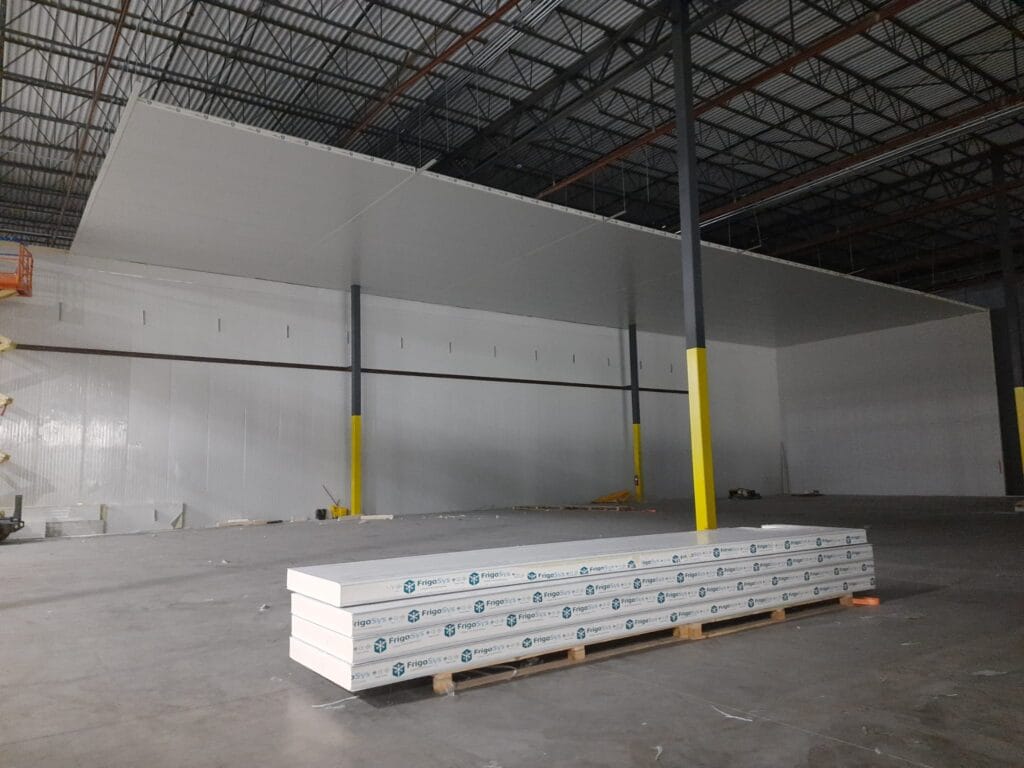
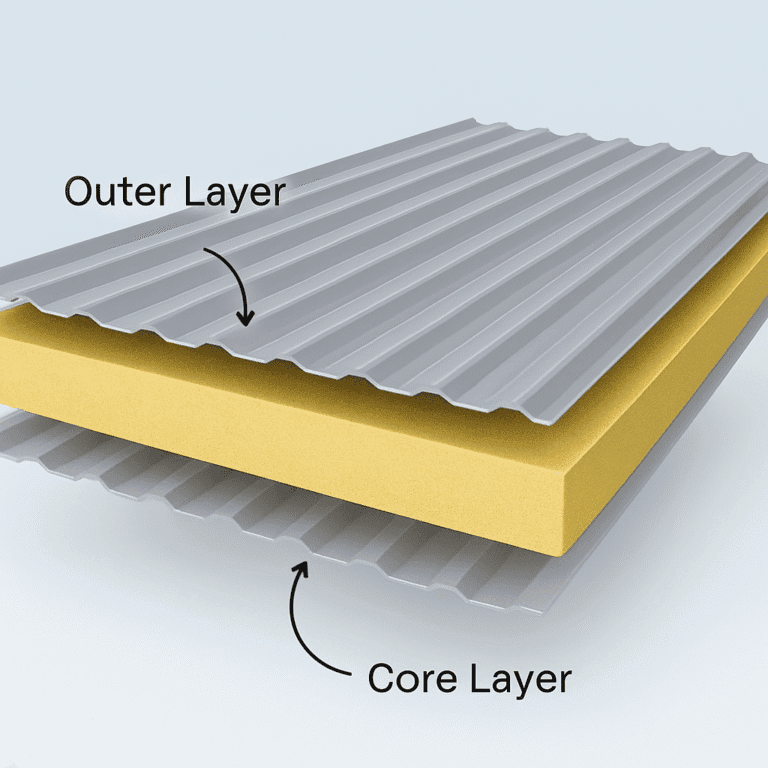
Here is the single most important technical fact in this entire discussion: PIR (polyisocyanurate) cores can achieve FM 4880 Class 1 listings, while standard polyurethane (PUR) cannot. Mineral wool cores also qualify, but PIR is usually the preferred choice for cold storage because it delivers far better thermal performance per inch of thickness.
PIR is chemically a modified, higher-performance cousin of polyurethane. The higher isocyanate-to-polyol ratio produces a core that chars rather than melts and drips when exposed to flame, and that resists ignition far better than conventional PUR. That fire behavior is exactly what FM’s Class 1 tests reward.
The practical consequences for a cold storage builder are significant:
- Fire safety: PIR earns the Class 1 rating that insurers require; standard PUR does not qualify for FM 4880.
- Thermal efficiency: PIR has a lower thermal conductivity, so you reach the same R-value with a thinner panel — preserving usable interior volume within the same building footprint.
- Temperature range: High-density PIR performs down to roughly -50°C without material degradation, making it suitable for blast freezers and deep-freeze rooms, not just chilled storage.
- Moisture resistance: The closed-cell structure resists moisture ingress, protecting insulation value over the life of a wash-down cold room.
This is why serious U.S. cold storage specifications now default to PIR. It is the one common core material that satisfies both the insurer’s fire requirement and the engineer’s energy requirement in a single panel.
The Insurance Math: Why the Premium Pays for Itself
FM Approved PIR panels do cost more than non-rated PUR — typically an 8 to 18 percent premium on the panel line item, based on U.S. market data from 2026. For buyers focused on upfront cost, that premium can feel like an unnecessary upgrade. In practice, it is often the cheapest insurance decision in the entire project budget.
The reason is straightforward. When a cold storage building is constructed with FM Approved panels, the property insurer treats it as a materially lower fire risk. That translates directly into lower annual insurance premiums — and in a hardening 2026 insurance market, it can be the difference between getting a policy quoted and being declined outright. Industry estimates put the payback period on the panel premium at roughly 18 to 36 months through insurance-premium reduction alone, before you even count the reduced risk of a catastrophic loss.
Put simply: for insured cold storage, food processing, pharmaceutical, cannabis cultivation, and data center projects, FM 4880-rated panels are no longer optional. The panel premium is small, recurring, and predictable. The cost of an uninsured — or uninsurable — refrigerated warehouse is not.
FM Approval Versus Building Code: They Are Not the Same
A common misunderstanding among first-time cold storage buyers is treating a building-code fire rating and an FM approval as interchangeable. They are not.
U.S. building codes (the IBC) require interior finish materials to pass the Steiner tunnel test — UL 723 / ASTM E84 — which measures flame spread and smoke development. FM 4880 incorporates and goes beyond that test. In most jurisdictions, an FM 4880 listing is accepted as evidence of UL 723 compliance, meaning an FM Approved panel typically satisfies both the insurer and the local authority having jurisdiction (AHJ).
For multi-story or combustible exterior walls, code may also require NFPA 285 compliance. Some FM 4881 exterior-wall listings include NFPA 285 testing, but not all do — so if your project is above three stories or uses combustible exterior assemblies, verify NFPA 285 specifically rather than assuming it comes bundled with the FM listing.
The takeaway: FM approval is generally a higher bar than minimum code, which is precisely why insurers rely on it. Building to FM standards usually gets you code compliance as a byproduct, but the reverse is not true.
Where
FM Approved PIR Sandwich Panels Are Required
Not every project needs FM Approved panels, but the list of applications where they are effectively mandatory keeps growing. In the U.S. market, expect FM 4880 (and often 4881/4471) requirements for:
- Cold storage and refrigerated warehouses — the core application, especially insured distribution centers.
- Food processing and packaging plants — where FSMA compliance and insurer requirements overlap.
- Pharmaceutical and life-sciences facilities — often requiring FM 4882 for smoke-sensitive cleanrooms.
- Cannabis cultivation and processing — a fast-growing segment with strict insurer scrutiny.
- Data centers — hot and cold aisle containment and building envelopes.
If your facility falls into any of these categories and carries commercial property insurance, assume FM Approved PIR panels will be on the specification before you finalize your design.
What to Look For When You Specify FM Approved PIR Sandwich Panels
When you are sourcing panels for a U.S. project, a few practical checks separate a genuinely compliant supply from a risky one:
- Ask for the specific FM listing, not a general claim. The exact panel construction should be traceable to an FM approval record.
- Match the standard to the location. Interior walls and ceilings need FM 4880; exterior walls need FM 4881; roofs need FM 4471; smoke-sensitive rooms need FM 4882.
- Confirm the facer and thickness. FM listings are specific about steel gauge (commonly 0.50 mm+ PPGI, or stainless steel 304 for food-contact and wash-down zones) and panel thickness. For freezers, plan on 100–150 mm PIR; roof R-values for cold storage generally run from R-30 to R-60 depending on temperature class.
- Pay attention to joints and fasteners. FM approvals cover the assembly, including joint detailing and fastening systems — not just the core. In 2026, FM issued updated joint-detailing guidance, so make sure your installer follows the listed detail.
- Verify the core is genuine PIR, not fire-retardant-modified PUR marketed as equivalent. Only the correct core earns the listing.
The Frigosys Approach: FM-Grade PIR at a Competitive Cost
Frigo System (Frigosys) manufactures high-density PIR insulated sandwich panels engineered specifically for the fire and thermal performance that FM standards demand. Our panels use a 42 kg/m³ (±2) PIR core with interlocking camlock joints, available in thicknesses from 60 mm up to 200 mm, with pre-painted galvanized, stainless steel, or PVC facers to match food-contact, wash-down, and cleanroom requirements.
Because we produce panels and complete cold room systems in Turkey and export directly to the U.S. market, buyers typically see a meaningful cost advantage versus domestic suppliers — often in the range of 30 to 45 percent on comparable specifications — without compromising on the PIR core fire performance that FM approval is built around.
One important note for buyers: FM approval is a panel-specific listing, so when your project requires formally FM Approved panels, we will confirm the exact FM-listed specification for your build before quoting. If your project needs FM 4880 interior panels, FM 4881 exterior walls, or an FM 4471 roof assembly, tell us up front and we will engineer the panel package to the listed detail.
Ready to Spec Your Cold Storage Panels?
FM Approved PIR sandwich panels are now the fire-safe standard for insured cold storage in the United States — and for good reason. They protect your building, keep it insurable, and pay back their modest premium in under three years. The key is starting with the right core material: high-performance PIR, engineered and installed to the listed FM detail.
If you are planning a cold room, blast freezer, or refrigerated warehouse and want a cost-competitive PIR panel package built to U.S. fire and insurance requirements, contact Frigo System for a free quote and tell us which FM standards your project needs to meet.