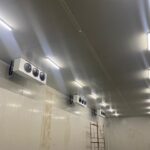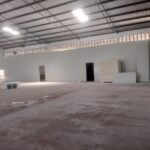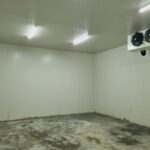


Table grapes should be stored at -1 to 0 °C (30-32 °F) with 90-95% relative humidity, and the pulp should stay between -0.5 and 0 °C for the whole storage period. Getting there depends on three things: fast pre-cooling after harvest, sulfur dioxide (SO2) against gray mold, and a room that moves enough air without drying the stems.
Whether you pack seedless grapes for the local market or prepare red varieties for a long sea voyage, the problems are the same. Grapes lose water quickly after harvest, stems dry and brown, berries shatter, and gray mold spreads from berry to berry. This guide covers temperature, humidity, pre-cooling, SO2, controlled atmosphere and room design in that order.
What temperature should a grape cold store run at?
The recommended room temperature for mature table grapes is -1 to 0 °C. Grapes are not chilling sensitive, so the real limit is freezing. The freezing point of the berries depends on sugar content; published values sit between roughly -2 °C and -3 °C. The stem freezes before the berries, and stem injury can start around -1 °C. Setting the room below -1 °C is therefore risky, especially for less mature lots and newer varieties, which are more sensitive to stem freezing.
Stability matters as much as the set point. Gray mold (Botrytis cinerea) can still grow at about -0.5 °C, so cold alone does not stop it, and a room that swings up and down speeds up both decay and water loss. For other products, see our overview of cold storage of fruit and vegetables.
Humidity and air speed: keeping the stems green
The stem of a grape cluster respires about 15 times faster than the berries, so water loss and browning show up there first. Keep the room at 90-95% RH. Lower humidity dries the stems, increases berry drop and ruins the look of the fruit.
Sources differ slightly on air speed. The University of California guideline suggests a moderate air velocity of about 0.10-0.20 m/s (20-40 ft/min) during storage, while an international storage manual gives 0.25-0.38 m/s (50-75 ft/min) between pallet lanes. The practical point is the same: air must reach every pallet evenly, but it should not race over the fruit and dry it out. Evaporator selection and air distribution have to be designed around that balance. Our guide to cold storage humidity control explains the details.
Pre-cooling: the first hours after harvest
If grapes enter storage warm, the loss starts before storage does. Respiration is 1-2 ml CO2/kg·h at 0 °C but 12-15 ml CO2/kg·h at 20 °C, so warm fruit from the field ages roughly ten times faster than cooled fruit. Cooling should start as soon as possible, and SO2 should be applied within 12 hours of harvest.
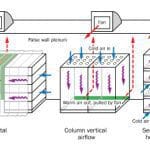
Many grape pre-coolers in California are designed to reach 7/8 cooling, closing seven-eighths of the gap between fruit and target temperature, in 6 hours or less. The usual method is forced-air cooling: pallets are set in two rows, covered on top and sides, and a fan pulls cold air through the boxes. Pre-cooling is best done in a separate room with high refrigeration capacity, high air speed and high humidity; cooled pallets then move to the storage room. We design and build forced-air pre-cooling rooms ourselves, with the fan wall, tarp and air plenum. Read more on forced-air cooling.
SO2 treatment basics
Gray mold is the most destructive storage disease of table grapes, and fast cooling alone does not control it. The common practice has two parts:
- Room fumigation: a first SO2 treatment right after packing, then lower-dose treatments every 7-10 days in storage. Research shows that a concentration-times-time product of at least 100 ppm·h is needed to kill Botrytis spores at 0 °C. Doing the first fumigation during forced-air cooling pushes the gas into the centre boxes of each pallet.
- SO2 pads in the box: for sea shipments longer than about 10 days, or long retail periods where fumigation is impossible, slow-release SO2 pads are used together with a perforated polyethylene liner.
Overdosing causes damage too. Immature, warm or cracked berries bleach easily, and the injury grows as storage goes on. In a Turkish study on Sultani Çekirdeksiz (Thompson Seedless), residues in modified-atmosphere bags with a single SO2 generator exceeded the 10 ppm limit after the second month. Check the residue rules of your target market in advance, and leave gas treatments to trained staff.
Is controlled atmosphere worth it for grapes?
The honest answer: the benefit is less clear than for apples or pears. US postharvest guidelines say that CA at 2-5% O2 and 1-5% CO2 is not currently recommended for table grapes, because the gain is slight and decay is already controlled with SO2. On the other hand, high CO2 does help: 10-15% CO2 in air can hold back gray mold for 2-4 weeks depending on the variety, and 5-10% CO2 combined with CA has been reported to control decay about as well as SO2.
Results depend on variety and harvest timing. In a trial on Thompson Seedless, at least 15% CO2 was needed to control decay; 15% CO2 with 3-12% O2 was suggested for up to 12 weeks for late-harvested fruit, while early-harvested fruit showed stem and berry browning above 10% CO2 and CA was not recommended for it. A Turkish study on Sultani Çekirdeksiz concluded that a controlled-atmosphere module combined with SO2 generators allowed 150 days of storage. CA for grapes is therefore not a drop-in replacement for SO2; it is an option to test against your variety, maturity and market. See how the system works on our controlled atmosphere cold storage page.
Storage life by variety
How long grapes last depends on the variety, maturity at harvest, rain before harvest and temperature management. Published ranges:
| Variety / group | Conditions | Storage life in the sources |
|---|---|---|
| European (Vitis vinifera) table grapes, general | -1 to 0 °C, 90-95% RH | 2-6 months |
| Red Globe, Crimson Seedless, Emperor, Ribier | Same, with SO2 | Listed among the longest-storing varieties |
| Thompson Seedless (Sultanina), Flame Seedless | Same, with SO2 | Marketed up to 8-10 weeks after harvest in California |
| Sultani Çekirdeksiz (Turkish study) | 0 °C, 90±5% RH, CA module + SO2 | 150 days |
| American types (Concord etc.) | -0.5 to 0 °C, 85-90% RH | Not suited to long storage: rarely keeps well beyond 3-4 weeks (1-2 months in the source’s table); too sensitive to SO2 to be fumigated |
Designing a grape cold store
Keep pre-cooling and storage apart
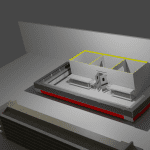
Pre-cooling needs a lot of capacity; storage needs a steady temperature and gentle air. Doing both in one room cools warm fruit slowly and dries out the cold fruit already inside. Size the plant on entry temperature, daily intake and respiration heat together; our cold room heat load calculator is a good starting point.
Insulation and panels
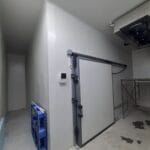
Because the room runs at -1 °C, walls, ceiling and floor must be insulated for summer peak conditions. For rooms around 0 °C, such as -1/0 °C grape rooms, we use 80-100 mm panels; for -18/-25 °C frozen stores the thickness is 120-150 mm. The exact value follows from the local outdoor temperature and the heat load calculation. If the site also has a frozen store, its floor needs heating to stop the ground from freezing; we do this with electric heating cable (see floor heating for cold storage). Tight joints protect both energy use and the humidity balance. See our cold room panels.
Humidity, airflow and doors
A design with a small temperature difference between evaporator and room removes less moisture from the air. Leave air lanes between pallet rows, and limit warm air at busy forklift entrances with high-speed or sliding doors.
How we build a grape cold store
We are headquartered in Istanbul and make PU/PIR sandwich panels, cold room doors and refrigeration systems in our own factory. On a grape storage project we work like this:
- We prepare the heat load calculation and room layout from your daily intake, varieties, storage period and target market.
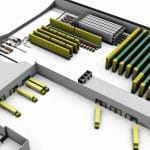
- We design and build the forced-air pre-cooling rooms (fan wall, tarp, air plenum) and the storage rooms ourselves; if you want controlled atmosphere, CA rooms can be planned in the same project.
- We select camlock or non-camlock panels, floor panels, hinged, sliding and high-speed PVC doors, and monoblock, split, open-type condensing units or central systems to suit the site. Our standard refrigerants are R404A, R449A/R448A and R134a/R513A.
- Our remote monitoring system sends alarm notifications, and room temperatures can be followed remotely.
- Production takes 3-7 weeks depending on the project. Abroad, our own team installs or we send a supervisor. Delivery is EXW or CIF depending on the country, and payment is by L/C or T/T with terms agreed per order. All our products carry the CE marking, the warranty is one year and spare parts ship in 3-5 days.
With more than 15 years of experience, we supply 40+ countries; we have completed more than 100 turnkey projects and supplied products to more than 500 companies. For an overview of fruit storage projects, see fruit and vegetable storage.
Frequently asked questions
What temperature should table grapes be stored at?
Keep the room at -1 to 0 °C and the pulp at -0.5 to 0 °C, with 90-95% relative humidity. Do not set the room below -1 °C, because the stems freeze before the berries.
How long can table grapes be kept in cold storage?
For European-type table grapes the sources give 2-6 months. Varieties such as Thompson Seedless usually store for shorter periods, while Red Globe and Crimson Seedless store longer. Maturity, rain before harvest and temperature control all change the result.
Do grapes need controlled atmosphere storage?
No. The standard approach is cold storage with SO2. Some studies show good decay control with high-CO2 atmospheres, but results vary with variety and harvest time, and high CO2 can brown early-harvested fruit. CA is worth evaluating for long storage or where lower SO2 residues are a goal.
Should I use SO2 pads or room fumigation?
They do different jobs. Grapes held in a cold store are fumigated at regular intervals; pads with perforated liners protect the fruit during long sea transport and retail, where fumigation is not possible. With both, watch the dose and the residue limits of your market.
How fast should grapes be pre-cooled?
Start immediately after harvest. Many forced-air grape coolers in California are designed to reach 7/8 cooling in 6 hours or less, and SO2 should be applied within 12 hours of harvest.
To size your grape store, the number of rooms and the pre-cooling capacity together, write to us through our contact page; we reply and send a quotation within 24 hours.