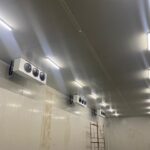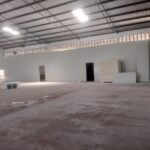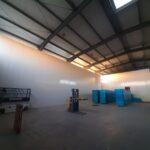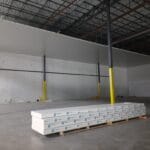


A 100-tonne cold store needs roughly 260 to 800 m³ of room volume depending on the product and how it is stacked, which at a 5–6 m internal height means about 45 to 135 m² of floor. Heavy pallets of frozen meat in a dense block sit at the small end of that range and light pallets with easy access to every one at the large end; crated fruit and vegetables fall in the middle at about 300–370 m³.
Below we turn tonnes into volume, floor area and pallet positions, explain why refrigeration capacity (kW) follows the heat load rather than the tonnage, and work through 50, 100 and 500-tonne examples. The figures are for early planning; for the wider layout questions see our cold storage design guide.
Why tonnage alone is not enough
Capacity is quoted in tonnes, but a room is built as a volume. How many tonnes fit depends on storage density and stacking; FAO’s meat cold store manual defines storage density as the quantity of product per unit of volume and builds its planning on it. A 300 m³ room holds one tonnage of apples crated to the ceiling and a very different tonnage of frozen meat on racks where a forklift must reach every pallet.
So the first number you need is storage density: average kilograms of product per cubic metre of room, including packaging, gaps, air clearances and aisles.
Storage density by product (kg/m³)
| Product and stacking | Density | Source and note |
|---|---|---|
| Apples in boxes or bins, controlled atmosphere room | about 320–335 kg/m³ of empty room volume | NRAES-22 (Cornell): 20–21 lb/ft³, converted by us. |
| Cabbage in pallet boxes | about 270 kg/m³ | NRAES-22: 17 lb/ft³. |
| Potatoes in 50 kg bags, tall chambers | 3.4 m³ per tonne, about 295 kg/m³ | India NHB technical standard, 1,250-tonne chamber example. |
| Frozen boneless meat in cartons, 100×120 cm pallets of 800 kg | 125 (good access) – 230 (dense block) kg/m³ of gross volume | FAO meat cold store manual, Table 4. |
| Same product, about 1,520 kg per pallet | 200 – 380 kg/m³ gross | FAO, Table 4. |
| Frozen meat cartons, block stacked without pallets | 370 – 630 kg/m³ gross | FAO, Table 4. |
| Frozen beef hindquarters on racked pallets | 80 – 150 kg/m³ gross | FAO, Table 4. |
The main lesson: access decides density more than the product does. In the FAO data, cartons stored ten rows deep reach almost twice the density of a layout only two rows deep, where every pallet is easy to reach. A busy distribution store holds fewer kilograms per cubic metre than a seasonal store filled and emptied once.
Net area, gross area and the square metres people forget
Net area is where product actually stands; gross area is the inside floor of the room. According to FAO, gross area is about 25 % larger than net area and gross volume about 50 % larger than net volume. The difference goes into:
- Aisles: FAO gives 2.15–3.0 m for forklift gangways, depending on the truck.
- Wall and pallet gaps: 15–20 cm along walls and 5–10 cm between pallets.
- Ceiling clearance: 40–60 cm between the top of the stack and the ceiling, which the evaporator needs to move air.
- Doors: 1.80–2.10 m wide for mechanical handling and 2.20–2.80 m high for normal pallet trucks (FAO).
- Space outside the rooms: anteroom, loading dock, machine room and any pre-cooling room. The densities above cover the storage rooms only. FAO recommends a loading dock at least 6 m deep, preferably 8–10 m.
Cold storage pallet sizes and weight per pallet
ISO 6780 lists six principal pallet sizes. The two you meet most often in cold stores are 1200×800 mm (the EUR pallet, 0.96 m²) and 1200×1000 mm (1.2 m²). In North America 1219×1016 mm (48×40 in) is common, and FAO treats it as comparable to 1200×1000 mm.
Weight per pallet varies a lot. FAO’s table has two examples for frozen boneless meat on a 100×120 cm pallet: 32 cartons of 25 kg for 800 kg, and 66 cartons of 23 kg for about 1,520 kg. The same table lists 1,200 kg per racked pallet of frozen beef hindquarters and 640 kg for fresh hindquarters hung on a pallet rack. For fruit and vegetables, weigh one of your own loaded pallets, and check the pallet’s load rating with its supplier.
FAO notes that a pallet load of carcass meat can reach 1.9 m in height and that stacks of 2–4 pallets are the most common. Number of pallets = total tonnes ÷ tonnes per pallet; in a racked store each pallet needs one rack position.
Worked examples: 50, 100 and 500 tonnes
Three steps: volume = tonnes ÷ density, floor area = volume ÷ internal height, pallets = tonnes ÷ weight per pallet. For fruit and vegetables we used the 272–336 kg/m³ range from the apple, cabbage and potato data above; for frozen meat the 125–380 kg/m³ range FAO gives for palletised cartons. The internal heights (5 m for produce, 6 m for frozen) are assumptions.
| Capacity | Product | Room volume | Floor area (inside) | Pallets |
|---|---|---|---|---|
| 50 t | Fruit and vegetables, 5 m high | 149–184 m³ | 30–37 m² | depends on your pallet weight |
| 100 t | Fruit and vegetables, 5 m | 298–368 m³ | 60–74 m² | depends on your pallet weight |
| 500 t | Fruit and vegetables, 5 m | 1,488–1,838 m³ | 298–368 m² | depends on your pallet weight |
| 50 t | Frozen meat, palletised cartons, 6 m | 132–400 m³ | 22–67 m² | 33 (1,520 kg) – 63 (800 kg) |
| 100 t | Frozen meat, 6 m | 263–800 m³ | 44–133 m² | 66 – 125 |
| 500 t | Frozen meat, 6 m | 1,316–4,000 m³ | 219–667 m² | 330 – 625 |
The frozen range is wide because heavy pallets in a dense block and light pallets in fully accessible racks are two very different stores. Before budgeting, decide how heavy your pallets will be and how many different pallets you must reach each day. For temperatures and humidity by product, see our guides to cold storage of fruit and vegetables and cold storage of meat. FAO gives −18 to −25 °C as the usual range for frozen meat.
How many kW does a cold store need?
Short answer: it depends on the heat load, not on the tonnage. The load is made of:
- Product load: bringing incoming product down from field or process temperature to storage temperature, plus respiration heat for fruit and vegetables.
- Transmission through walls, ceiling and floor.
- Infiltration: warm, humid air entering each time a door opens.
- Internal loads: people, lights, fan motors, forklifts and defrost.
Product load is often the largest item. In the NRAES-22 example from Cornell, a room of about 286 tonnes of apples, loaded at 10 % of capacity per day and cooled to 0 °C within 24 hours, needs 14.1 tons of refrigeration (about 50 kW) of installed capacity including a 21 % safety allowance, and about 70 % of the calculated load is field heat. The same room, full in winter, needs less than 1.5 tons of refrigeration (about 5 kW). In one store, the need can change tenfold with the loading rate.
Rough W/m³ figures for a first estimate only
Preliminary only, not for equipment selection. Dividing the published loads of the example stores in our sources by their room volume gives:
- Apple room, 866 m³, peak during 10 %-per-day loading: about 57 W/m³; full room in winter: about 6 W/m³ (NRAES-22).
- Potato store, four chambers of about 18,400 m³ in total, loading period: about 20 W/m³; holding period: about 8 W/m³ (NHB).
- Frozen fish store, 1,000 m³ at −30 °C with 35 °C outside, allowances included: about 36 W/m³ (FAO).
A 100-tonne produce room of about 300–370 m³ would land somewhere between about 2 and 21 kW on these ratios. A range that wide is the clearest sign that “how many kW” needs a real calculation.
For real sizing, enter your room dimensions, product and daily intake in our cold room heat load calculator; the method behind it is explained in calculating cooling load.
Cooling kW is not the same as compressor motor kW
The cooling capacity in a catalogue is the heat removed from the room. The electrical power the compressor draws is a fraction of it, set by the coefficient of performance (COP). India’s NHB standard asks the large potato stores it describes for a COP of at least 3.6 at peak load and 3.3 during holding. At that ratio 20 kW of cooling takes roughly 5.5–6 kW of electrical power. COP is lower in frozen stores, so the same cooling costs more electricity.
Plan pre-cooling and freezing separately
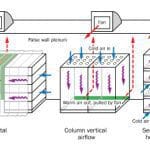
Cooling warm product in the storage room is slow and forces you to size the plant for the busiest loading days. In North Carolina State University’s example, forced-air cooling reaches its target in 0.5–1.5 hours depending on airflow, while still-air room cooling takes many hours. Stores with fast intake therefore often add a separate forced-air pre-cooling section. We design and build these pre-cooling rooms too, with the fan wall, tarp and plenum. If product arrives to be frozen, the freezing belongs in a blast freezer room; the storage room only holds product that is already frozen.
How we build a store like this
We start from your product, yearly and daily intake, stacking method and site dimensions, and calculate capacity and heat load from those. The room shell is built from PU or PIR sandwich panels made in our own factory, with camlock and non-camlock options and floor panels; FM-approved panels are part of the range. Panel thickness follows the room temperature: we use 80–100 mm panels for rooms around 0 °C and 120–150 mm for −18/−25 °C stores. Frozen stores can get floor heating with electric heating cable to protect the slab from frost.
Doors are chosen for the traffic: hinged, sliding, flip-flap, high-speed PVC and industrial doors. On the refrigeration side we use monoblock, split or open-type condensing units, or a central system, depending on volume and load. Our standard refrigerants are R404A, R449A/R448A and R134a/R513A, and the remote monitoring system sends alarm notifications and lets you follow room temperatures remotely.
Production takes 3–7 weeks depending on the project. Abroad, our own team installs or we send a supervisor. Delivery is EXW or CIF depending on the country; payment is by L/C or T/T with terms agreed per order. All our products carry CE marking, come with a 1-year warranty, and original spare parts can be supplied within 3–5 days. We have more than 15 years of experience, work in more than 40 countries and have completed over 100 turnkey projects.
Frequently asked questions
How many m² is a 100-tonne cold store?
About 60–74 m² of inside floor for tightly stacked fruit and vegetables at 5 m internal height, and about 44–133 m² for palletised frozen meat at 6 m. Anteroom, loading dock and machine room come on top.
What is the standard cold storage pallet size?
ISO 6780 includes 1200×800 mm and 1200×1000 mm, the two sizes most used in cold stores; 1219×1016 mm (48×40 in) is common in North America. Design rack bays and door widths around the pallet you will actually use.
How much does one pallet of product weigh?
It depends on product and cartons. FAO’s frozen meat examples on a 100×120 cm pallet range from 800 kg to about 1,520 kg; for produce, weigh your own loaded pallet.
How many kW of refrigeration does a cold store need?
It depends on intake rate, product temperature on arrival, insulation and door traffic. The examples in our sources range from about 6 to 57 W/m³, so the equipment should be selected with the calculator and a project calculation.
Can chilled and frozen products share one store?
Not in the same room, because they need different temperatures. Chilled and frozen rooms can stand side by side in one building, each calculated for its own temperature.
Send us your product, tonnage and site dimensions through our contact page; we reply within 24 hours and prepare your quotation together with the capacity calculation.