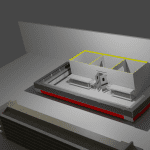
Frigo System supplies cold rooms to Tanzania from Turkey. We design each project around what you store and where you build, then ship the sandwich panels, cold room doors and refrigeration units in containers. Typical projects are freezer stores and blast freezers for fish, meat and poultry, cold rooms for fruit, vegetables and dairy products, and complete cold stores. We have already exported to Tanzania: in Arusha our own team installed a freezer store with two cold rooms, and our local representative in Tanzania installs and commissions new cold rooms.
Cold rooms for Tanzania at a glance
| Project in Tanzania | Arusha: a 22 × 17 × 4 m freezer store and two cold rooms of 10 × 6 × 4 m, one for yogurt and one for chocolate |
| Local contact | Our representative in Tanzania |
| What we supply | PUR or PIR panels from 60 to 200 mm, doors, refrigeration units, controllers and complete cold stores |
| Delivery terms | Ex works (EXW), or CIF to Dar es Salaam with sea freight included |
| Production time | 3–7 weeks on average, depending on the project |
| Payment | Letter of credit (L/C) or bank transfer (T/T), with terms agreed for each order |
| Installation | By our team or our local representative in Tanzania, or by your local team led by our supervisor |
| Warranty and spare parts | 1 year under standard terms; original spare parts supplied within 3–5 days |
| Certification | Our products carry the CE mark |
| Tanzania import certificate | TBS PVoC Certificate of Conformity (CoC): we obtained it ourselves for our Arusha project |
Our cold storage project in Arusha
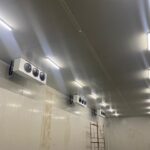
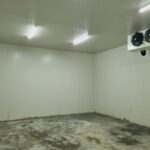
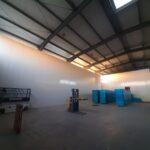
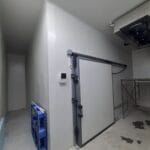
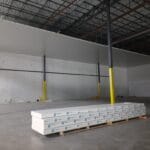
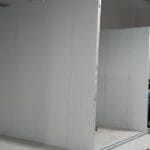
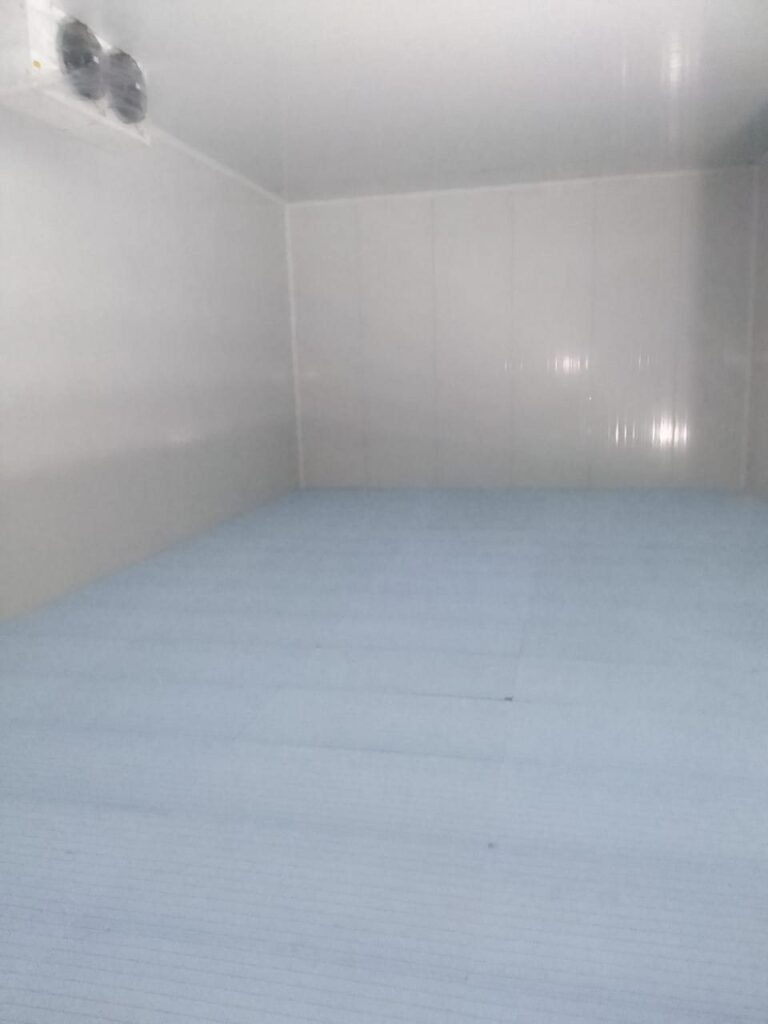
For a customer in Arusha we supplied and installed a cold store with three rooms, and our own team carried out the installation. The rooms stand inside a hall. The evaporators hang inside the rooms, and the condensing units stand outside on a steel platform.
- Freezer store: one room of 22 × 17 × 4 m, about 374 m² of floor area
- Yogurt cold room: 10 × 6 × 4 m, about 60 m²
- Chocolate cold room: 10 × 6 × 4 m, about 60 m²
- Import: we obtained the TBS PVoC Certificate of Conformity ourselves
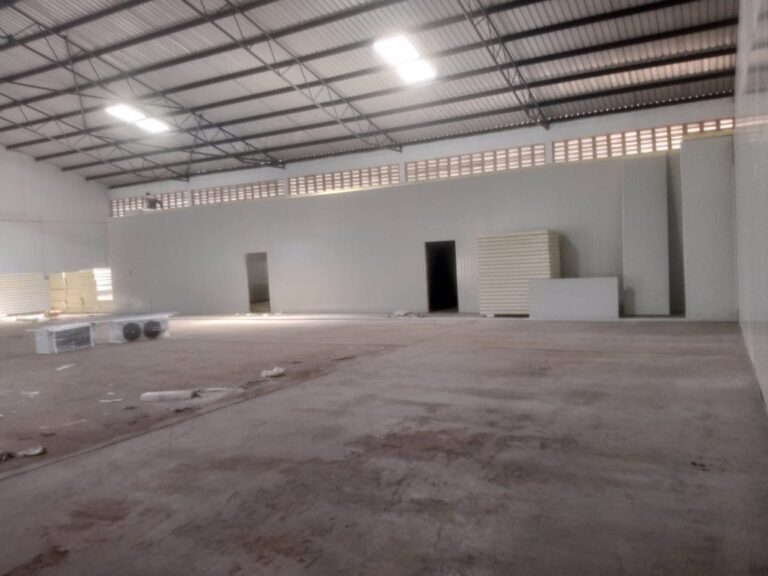
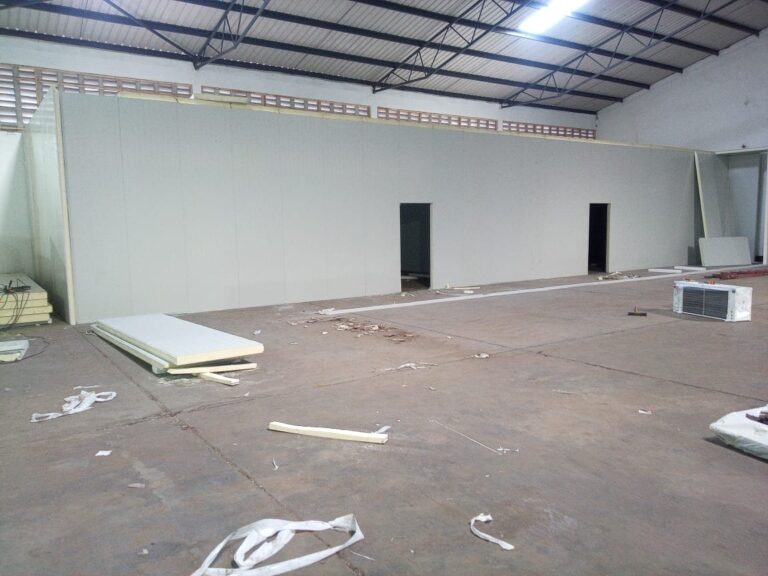
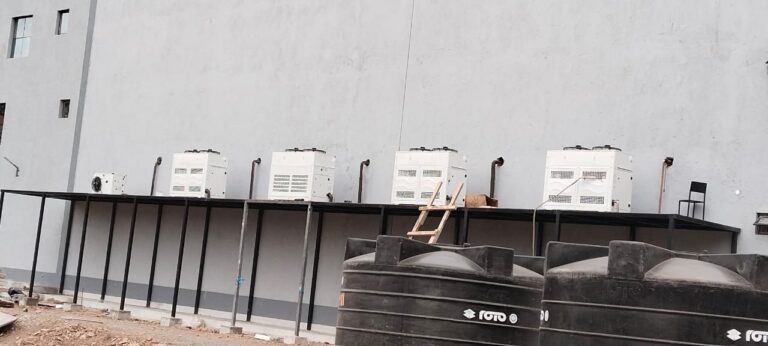
Our other East African projects are in Kenya: a fresh fruit cold room in Nairobi and a block of four freezer rooms and a cold room, see cold rooms in Kenya. Across Africa we have exported to Ghana, Kenya, Tanzania, Uganda, The Gambia and Senegal. Our page on cold rooms in West Africa covers Ghana, Senegal and The Gambia.
What we supply for cold rooms in Tanzania
- Cold room sandwich panels in PUR or PIR, 60 to 200 mm thick, for walls and ceilings, and floor panels for freezer rooms
- Cold room doors: hinged doors for small rooms, sliding doors for forklift traffic, high-speed PVC and industrial doors
- Refrigeration systems: monoblock and split units, condensing units and central systems for large stores
- Blast freezers and freezer rooms
- Modular cold rooms, container cold rooms and industrial cold rooms
Compressors come from Bitzer, Dorin, Frascold, Copeland and BOCK, electrical components from ABB, Schneider and LG, and controllers from Dixell and Eliwell.
Storage conditions for products in Tanzania
Cold rooms in Tanzania mostly keep fruit and vegetables, fish, meat and poultry, and dairy products. Every product has its own temperature and humidity, and a room set for the wrong product shortens its life. The values below are typical storage conditions and approximate storage life from the product data of our cold room calculator, which draws on USDA Agriculture Handbook 66, UC Davis, FAO and GCCA sources.
| Product | Temperature | Humidity | Storage life |
|---|---|---|---|
| Avocado (unripe) | 7 °C (3–13 °C, by variety and ripeness) | 85–95 % | 2–4 weeks |
| Mango (mature green) | 12 °C (10–13 °C) | 85–90 % | 2–4 weeks |
| Banana (green) | 14 °C (13–15 °C) | 90–95 % | 1–4 weeks |
| French beans | 5 °C (4–7.5 °C) | 95–100 % | 7–12 days |
| Potato (late crop, cured) | 7 °C (4–10 °C) | 95–99 % | 5–10 months |
| Onion (dry) | 0 °C | 65–75 % | 1–9 months |
| Fresh fish | 0–4 °C, best at 0 °C in ice | – | 1–2 weeks, by species |
| Yogurt | 2–4.4 °C | – | 35–45 days |
| Chocolate | 0–21 °C; the colder, the longer it keeps | 50–55 %, never above 65 % | 6 months at 0 °C, 3 months at 10 °C, 1 month at 21 °C |
| Frozen meat, poultry and fish | –18 °C or colder | – | About 12 months for beef and poultry, 4–12 months for fish |
Avocados, mangoes and bananas suffer chilling injury below their range, so they need a different room from vegetables kept near 0 °C. Chocolate needs dry air, while yogurt needs a cold room at 2–4.4 °C; in our Arusha project each of them has its own room.
The calculator covers more than 30 fruits and 30 vegetables and works out the cooling load of your room. Our guides to cold storage of fruit and vegetables and potato cold storage conditions go into more detail.
Blast freezers and freezer stores
For fish from Lake Victoria and the coast, and for meat and poultry, we build blast freezer rooms that run at –35 to –40 °C with 200 mm PUR or PIR panels. The frozen product then goes into a freezer store at –18 °C or colder. Freezone (AF) units serve industrial plants, and Freezone Mini (AFM) units freeze 45 to 1,000 kg of product a day for smaller businesses. In our Sri Lanka project, the blast freezing room freezes 3 tonnes of product to –20 °C in as little as 5 hours. Read more in our guide to blast freezer rooms and on our pages about fish cold storage and freezing and meat storage.
Planning a cold room in Tanzania
- Climate: Dar es Salaam and the coast are hot and humid, while Arusha and the northern highlands are cooler. We choose the condensing units for the hottest weather at your site; our guide to high ambient condensing units explains why.
- Power supply: the low-voltage grid in Tanzania supplies 400 V three-phase and 230 V single-phase at 50 Hz. Larger refrigeration units need a three-phase connection, so tell us what is available at your site.
- Products and daily intake: what you store, how much comes in each day and at what temperature. Fruit and vegetables often need forced-air pre-cooling before storage, and fish or meat to be frozen needs a blast freezer before the freezer store.
- Separate rooms: products with different temperature or humidity needs get their own rooms, as yogurt and chocolate did in Arusha.
- Doors and loading: sliding doors for forklifts and pallets, hinged doors for small rooms and high-speed PVC doors for busy entrances.
- Building: the panels can form rooms inside an existing hall, as in Arusha, or stand in a new building.
Delivery to Tanzania: from order to installation
- Quotation: ex works (EXW), or CIF Dar es Salaam with sea freight included.
- Payment: L/C or T/T, with terms agreed for each order.
- Production: 3–7 weeks on average, depending on the project.
- Packing and loading: panels, doors and refrigeration units are packed at our factory and loaded into 40 ft containers; a cold store of about 600 m² needs about 4–5 containers.
- Documents: commercial invoice, packing list, installation plan, user manual, certificate of origin, bill of lading and the required quality certificates. Regulated goods entering Tanzania need a Certificate of Conformity (CoC) under the PVoC programme of the Tanzania Bureau of Standards (TBS); for our Arusha project we obtained it ourselves.
- Installation: our team or our local representative in Tanzania installs and commissions the cold store, or our supervisor leads your local team.
- After installation: 1 year of warranty under standard terms, and original spare parts within 3–5 days.
The CIF price covers sea freight to Dar es Salaam. Customs clearance, import duties and transport from the port to your site are not included.
What does a cold room cost in Tanzania?
Size, temperature, panel thickness, doors, refrigeration and installation decide the price. One example from Africa: a frozen store of three rooms and about 600 m² at –18 °C, like our Banjul project in The Gambia, costs about €160,000 ex works today, with installation and commissioning included; sea freight is added by country. Our cold room price guide explains the 10 factors behind the price.
Frequently asked questions
Do you deliver cold rooms to Tanzania?
Yes. We have already exported to Tanzania, and our own team installed a 22 × 17 × 4 m freezer store with a yogurt cold room and a chocolate cold room in Arusha.
Who installs the cold room in Tanzania?
Our team or our local representative in Tanzania installs and commissions it, or we send a supervisor to lead your local team. The Arusha project was installed by our own team.
How long does delivery to Tanzania take?
Production takes 3–7 weeks on average, depending on the project, and the sea voyage to Dar es Salaam comes on top of that.
Do you handle the TBS PVoC certificate?
For our Arusha project we obtained the Certificate of Conformity (CoC) under the TBS PVoC programme ourselves. Tanzania requires a CoC to clear regulated goods through customs.
Can you build cold rooms for dairy products and chocolate?
Yes. In Arusha we built separate cold rooms of 10 × 6 × 4 m for yogurt and for chocolate. Yogurt keeps at 2–4.4 °C, and chocolate needs cool, dry air at 50–55 % humidity. See also our guide to cooling systems for dairy products.
Will the refrigeration cope with the heat in Dar es Salaam?
Yes, when the condensing units are sized for it. We select them for the summer temperature at your site, so a cold room in Dar es Salaam gets units for a higher outdoor temperature than one in Arusha.
Do you have a representative in Tanzania?
Yes, our local representative in Tanzania installs and commissions cold rooms. Send your request to us and we will put you in touch.